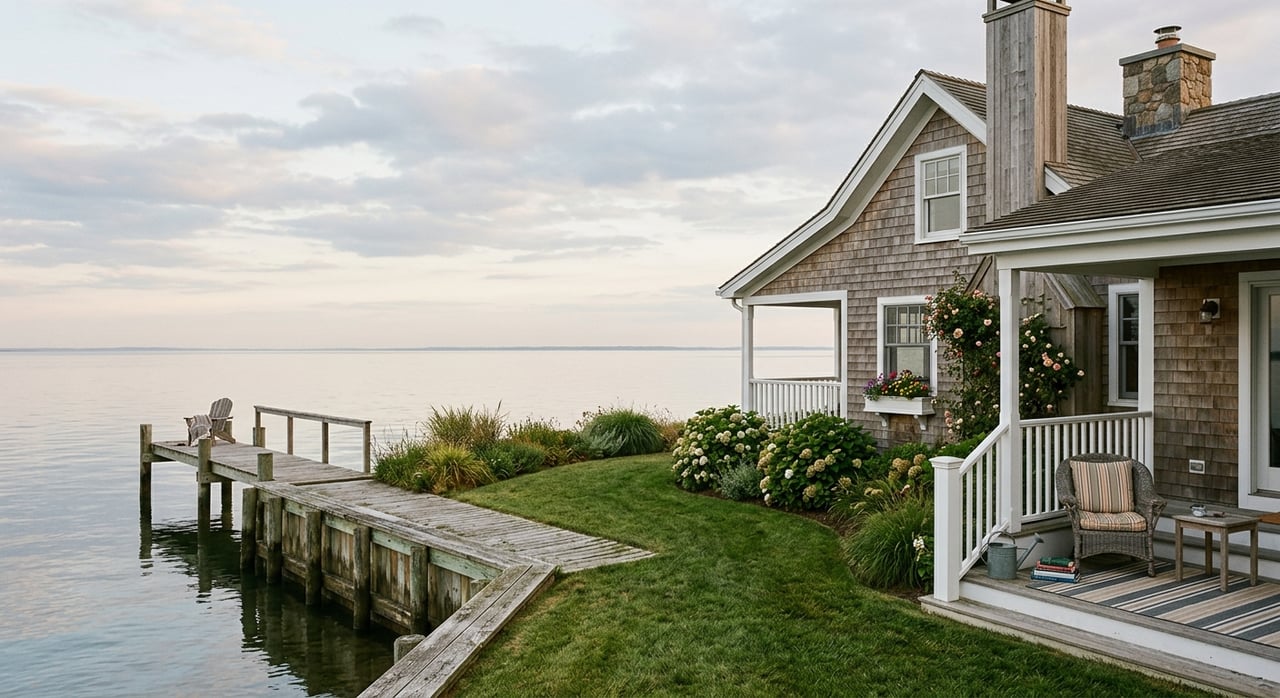
What Oxford Sellers Should Know About Waterfront Pricing
May 14, 2026
May 14, 2026
If you own waterfront property in Oxford, pricing it can feel deceptively simple. After all, water is the headline feature. But in a small, waterbound village like Oxford, two homes with water views can land in very different price ranges depending on what the shoreline actually offers, what is legally permitted, and how the home itself compares. That is why smart pricing starts with the details of your property, not just a townwide average. Let’s dive in.
Oxford is not just a town with some waterfront homes. It is a waterbound village with a long maritime history, and that identity shapes buyer expectations from the start.
That also means waterfront pricing here is especially sensitive. Market snapshots can swing quickly because inventory and sales volume are small. Recent reporting showed just 9 waterfront homes for sale with a median list price of $750,000 and only 2 waterfront sales in the past month, while another broader Oxford snapshot showed 20 homes for sale with a median listing price of $995,000 and a much longer median time on market.
For you as a seller, that gap matters. It tells you broad averages can be helpful for context, but they are not enough to set an asking price for a specific waterfront home.
In Oxford, one waterfront home is not interchangeable with another. Recent sales ranged from about $670,000 for a home with Town Creek views to $2.0 million for direct Town Creek waterfront, $1.2 million for Boone Creek waterfront, $2.7 million for a deep-water Holly Harbor property, and $5.9 million for a standout Morgan’s Point estate.
That spread is the real story. Buyers are not pricing your home based only on the word “waterfront.” They are looking at usable water access, water depth, frontage, shoreline setup, views, and overall home condition.
This is why automated estimates often miss the mark in Oxford. They may recognize location, but they usually cannot fully capture the real-world value of dockability, exposure, legal improvements, or a unique shoreline configuration.
One of the biggest pricing mistakes sellers make is assuming all shoreline adds value in the same way. In Oxford, buyers typically pay more when the property offers water access they can actually use.
For example, recent sales show how much dock and depth details can matter. One Boone Creek property offered 2 feet of mean low water, a private dock with water and electric, and an 8,000-pound lift. Another property in Holly Harbor had a private dock with more than 6 feet of mean low water. A Town Creek home included a floating dock with 5 feet of water depth.
Those are not small details. They shape how a buyer imagines using the property, whether for boating, seasonal recreation, or simple waterfront convenience.
Water depth can have a direct effect on buyer demand. If your property offers deeper water, it may appeal to a different buyer pool than a home with shallow shoreline and no practical dock use.
That does not mean shallow-water homes cannot command strong prices. It means your pricing should reflect the kind of water lifestyle your property truly supports.
A dock is valuable, but only if buyers understand what is there and what is allowed. In Oxford, waterfront structures are regulated locally, and certain improvements require approvals.
The town says permitting is required for many projects, including work within the 100-foot Critical Area Buffer. Oxford’s Board of Port Wardens regulates piers, moorings, and related waterfront structures, and permits from state and federal agencies must also be obtained before construction. The town code also limits new private piers to 150 feet long and 7 feet wide, and it does not allow dock-mounted or piling-mounted boat lifts within Town Creek.
If your property has an existing pier, lift, shoreline protection feature, or other waterfront improvement, those facts should be documented clearly during pricing and marketing. Buyers want certainty, and uncertainty can reduce perceived value.
Waterfront buyers notice frontage right away, but more frontage does not always create a simple dollar-for-dollar jump in price. Lot shape, shoreline usability, and how the house sits on the site all matter.
Recent sold examples in Oxford illustrate that point. Waterfrontage ranged from 115 feet to 200 feet to more than 1,000 feet among higher-priced sales, but the value difference was not explained by frontage alone.
A long stretch of shoreline can be a major asset if it comes with broad views, privacy, and practical access. But if the lot shape limits use, or the shoreline is harder to improve or maintain, the premium may be more modest than sellers expect.
Oxford buyers care about views, but views tend to command the strongest premium when they are paired with a useful waterfront setup. A broad western view over Town Creek or a southern exposure can be very attractive, especially when the home also offers docking or easy water enjoyment.
In other words, a beautiful outlook can lift value, but it usually works best as part of a full package. If your home has strong orientation, open vistas, and usable shoreline, those features should be weighed together.
It is easy to focus so much on the water that the home itself becomes secondary. Buyers do not see it that way.
Recent Oxford-area waterfront sales show that condition and amenities still move pricing in a major way. Features like excellent overall condition, updated systems, screened porches, garages, pools, fireplaces, and multiple garage bays all helped support stronger prices in the market.
That means your asking price should reflect more than the lot. If the home is well maintained, well designed for the setting, and ready for today’s buyer, that can support a stronger launch price than a similar waterfront parcel with a more dated or less functional home.
Waterfront buyers expect some extra homework, and sellers should expect those issues to affect pricing discussions. In Oxford, floodplain and shoreline regulations are part of the picture.
Oxford has a FEMA-certified floodplain manager, and the town notes that lenders normally require flood insurance in AE, VE, and LiMWA zones. The town also recommends flood insurance for all Oxford owners because some flood risk exists townwide.
Talbot County also says that private construction of a pier, bulkhead, or revetment in tidal waters requires a county zoning permit and a joint federal and state license from the Maryland Department of Environment. In addition, Maryland Critical Area rules apply to land within 1,000 feet of tidal waters, including a minimum 100-foot buffer that restricts certain new development or vegetation disturbance unless approved through local procedures.
For pricing, this matters in two ways. First, documented improvements and clear permitting history can help buyers feel more confident. Second, if a property has constraints on future changes, buyers may factor that into what they are willing to pay.
In a market as small as Oxford, your best comparable sales are usually not just “other waterfront homes.” The strongest comp set is often made up of properties on the same body of water, with a similar water-depth profile, and similar legal status for docks or shoreline improvements.
That means a Town Creek home may not be the best comp for a Boone Creek property, even if square footage is close. It also means a home with legal docking and deeper water should not be priced against a property that offers views but little practical access.
When pricing your waterfront home, focus on:
This kind of comp work is what helps move pricing from rough estimate to sound strategy.
Before your home hits the market, gather the facts that make your waterfront property easier to understand. The more clearly you can show what a buyer is getting, the easier it is to justify value.
A smart prep list may include:
This does not mean you need to overwhelm buyers with paperwork. It means you want the pricing story to be supported by facts.
If you are selling in Oxford, the most important thing to know is this: waterfront pricing is highly specific. A townwide median can give you background, but it cannot tell you what your shoreline, water access, legal improvements, and home condition are worth in today’s market.
The strongest pricing strategy looks at your property from the shoreline inward and the buyer outward. That means understanding how your home will be compared, what features truly set it apart, and where buyers may see added value or added caution.
In a market this nuanced, calm local guidance can make a real difference. If you are thinking about selling and want a pricing approach built around your specific waterfront property, reach out to Eddie Matthews for trusted Oxford insight and practical next steps.


Whether you’re buying your first home, selling a trust property, or navigating a probate sale, my goal is always the same: to provide honest guidance, strong advocacy, and a smooth experience from beginning to end. Real estate is about people, not just properties. I would be honored to help you take your next step.